



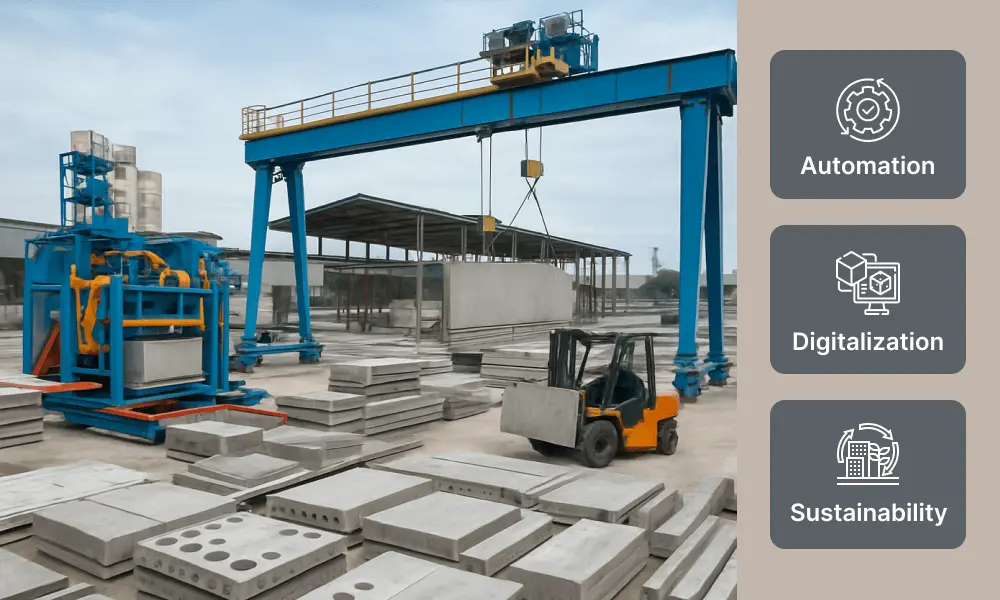
Precast Innovations 2026: How India Is Building Faster
India’s precast construction industry is entering a breakthrough phase in 2026. From automated factories and robotics to CNC moulds and digital quality control, precast manufacturers across the country are adopting smart technologies to build faster, safer, and more sustainably than ever before.
1. Automation: Driving Speed, Efficiency & Consistency
Automation has become a critical driver of productivity in Indian precast plants. Automated batching plants, concrete distribution systems, and pallet circulation systems are reducing dependency on manual labor while improving output consistency.
Key Benefits:
- Faster production cycles
- Reduced material wastage
- Improved workplace safety
- Consistent quality across batches
With rising labor costs and skill shortages, automated precast manufacturing is helping Indian factories meet tight construction timelines without compromising quality.
2. Robotics: Precision and Productivity at Scale
Robotic systems are increasingly being deployed for tasks such as reinforcement placement, shutter cleaning, concrete finishing, and demoulding. These machines ensure high precision and repeatability, which is essential for large-scale housing and infrastructure projects.
Applications of Robotics in Precast:
- Automated rebar tying and welding
- Robotic concrete spreading and compaction
- Surface finishing and polishing
Robotics not only improve productivity but also reduce human error, making them ideal for high-volume precast production in India.
3. CNC Moulds: Enhancing Design Accuracy & Flexibility
CNC-machined moulds are revolutionizing precast design capabilities. Unlike traditional moulds, CNC moulds offer superior accuracy, faster setup times, and the ability to produce complex architectural elements.
Why CNC Moulds Matter:
- High dimensional accuracy
- Easy customization for repetitive designs
- Reduced mould wear and longer life
- Faster turnaround for design changes
Indian precast manufacturers catering to commercial buildings, infrastructure, and architectural facades are rapidly adopting CNC mould technology.
4. Digital Quality Control: Data-Driven Manufacturing
Quality assurance in precast manufacturing is no longer limited to manual inspections. Digital quality control systems now track every stage of production — from raw materials to finished elements.
Digital QC Tools Include:
- IoT sensors for curing and temperature monitoring
- Automated strength and dimensional checks
- Digital inspection reports and traceability
- ERP and BIM integration
These systems help manufacturers comply with BIS standards, reduce rework, and deliver defect-free precast components.
5. BIM & Smart Factory Integration
Many Indian precast plants are integrating Building Information Modeling (BIM) with factory operations. This enables seamless coordination between design, production, and site installation.
Advantages:
- Clash-free designs
- Accurate quantity estimation
- Improved logistics planning
- Reduced project delays
BIM-enabled precast factories are setting new benchmarks for efficiency and predictability in construction.
Conclusion: The Future of Precast Manufacturing in India
With strong government focus on affordable housing, smart cities, metro rail, and infrastructure development, the demand for precast construction is expected to grow significantly. Factories that invest in automation, robotics, CNC moulds, and digital quality systems will lead the market in 2026 and beyond.
Innovation is no longer optional — it is the foundation of scalable, sustainable, and profitable precast manufacturing in India.
FAQs: Precast Manufacturing Innovations in India
1. Why is automation important for precast factories in India?
Automation improves production speed, consistency, safety, and reduces dependency on manual labor.
2. Are robotics affordable for Indian precast manufacturers?
Yes. With scalable solutions and long-term ROI, robotics are becoming increasingly viable for mid- to large-scale precast plants.
3. How do CNC moulds improve precast quality?
CNC moulds provide high precision, repeatability, and flexibility, ensuring accurate dimensions and superior finishes.
4. What role does digital quality control play in precast manufacturing?
Digital QC ensures real-time monitoring, traceability, compliance with standards, and reduced defects.
5. Is BIM adoption growing in the Indian precast industry?
Yes. BIM is increasingly used for design coordination, production planning, and site execution.